The Style
What Is Neo Japanese Traditional Tattooing?
Neo Japanese Traditional is a contemporary evolution of classic Japanese irezumi — it retains the bold outlines, iconic Eastern motifs, and flowing composition of the original style while expanding the rules around colour, shading, and artistic influence. Where traditional Japanese tattooing follows strict historical conventions, Neo Japanese welcomes creative freedom: richer colour palettes, more dimensional shading, Western illustration influences, and compositions that push beyond the borders of classic scroll and panel layouts.
The result is a tattoo that feels both rooted in a deep tradition and unmistakably modern. Neo Japanese pieces carry the visual weight and permanence of classical Japanese work, but with a vibrancy and flexibility that makes them easier to adapt to individual concepts, personal stories, and contemporary aesthetics. For clients who are drawn to Japanese imagery but want something more colourful or dynamic than traditional irezumi, Neo Japanese is often the natural answer.
Design Language
Motifs, Imagery, and Composition in Neo Japanese
Neo Japanese draws from the same rich visual library as traditional Japanese tattooing — koi fish, dragons, tigers, peonies, cherry blossoms, geishas, hannya masks, phoenixes, and waves remain central motifs. What changes is how these elements are rendered. In Neo Japanese, a koi fish may feature layered watercolour-like colour washes, deep iridescent scaling, and dimensional shadowing that gives it almost three-dimensional presence. A dragon may incorporate smoke effects, high-contrast highlights, and surreal colour gradients that would be considered outside traditional rules.
Composition in Neo Japanese is also more flexible. While traditional Japanese tattooing often follows the natural flow of limbs through scroll, sleeve, or panel formats, Neo Japanese compositions are more open — motifs can be isolated as standout pieces, combined with non-Japanese elements, or arranged in ways that emphasise the overall artwork rather than adherence to convention. This flexibility makes Neo Japanese one of the most versatile styles for sleeve projects, thigh panels, and large chest or back pieces.
Colour & Technique
What Makes Neo Japanese Colour and Technique Distinct
One of the defining characteristics of Neo Japanese tattooing is its approach to colour. Classical Japanese tattooing traditionally uses a defined palette — red, black, grey, and occasional greens and yellows. Neo Japanese breaks this palette wide open. Deep purples, electric blues, warm burnt oranges, turquoise, vivid greens, and complex gradient combinations are all part of the Neo Japanese toolkit. These colours are applied with sophisticated layering technique — not as flat fills, but as dimensional gradients that give the impression of depth, light, and movement.
Despite the expanded colour freedom, Neo Japanese retains the bold black outlines that define Japanese tattooing. These outlines serve a practical purpose — they hold the design together as it ages, keeping the composition readable even as colours soften over decades. The combination of strong linework and rich colour is what gives Neo Japanese tattoos their characteristic visual impact and long-term durability.
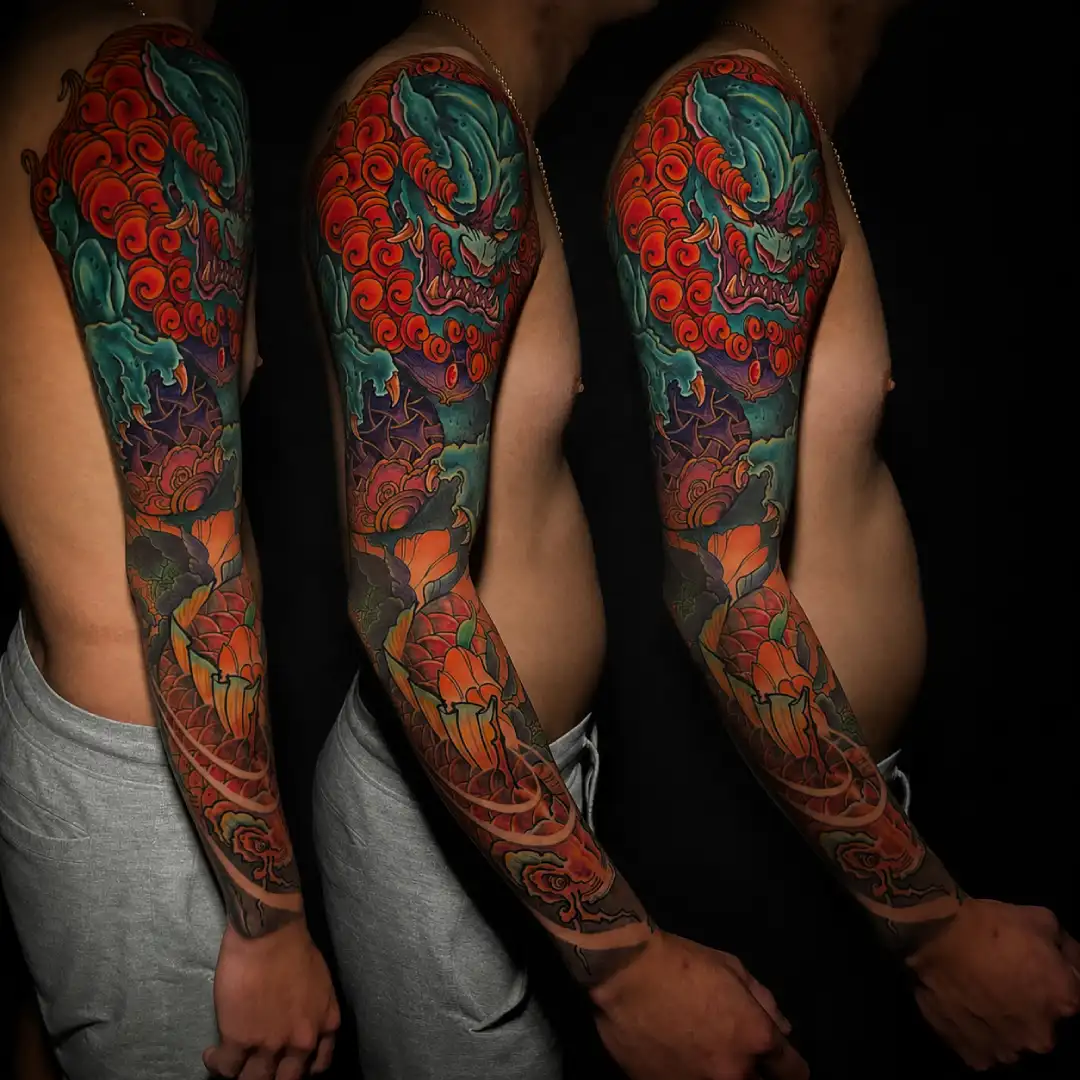
Neo Japanese tattoos are particularly well-suited to sleeve projects due to their compositional flexibility and ability to incorporate multiple elements — koi, waves, botanicals, and background fills — into a cohesive, flowing artwork. Multi-session planning is standard for full-sleeve work, with sessions typically spaced 4–6 weeks apart to allow proper healing between stages.
Body Placement
Where Neo Japanese Tattoos Work Best on the Body
Neo Japanese tattooing is at its strongest on large canvas areas where the composition has room to breathe. Full sleeves, half-sleeves, thigh panels, back pieces, and chest pieces all suit the style exceptionally well. The flowing compositions and large motifs require space to be read properly — compressed into a small area, the detail and colour depth that define Neo Japanese can be lost.
For clients looking to start with a smaller Neo Japanese piece, upper arms, calves, and outer thighs offer reasonable canvas size while still giving the design room to express itself. Talk to your artist at consultation about what scale makes sense for the motif you have in mind — some elements (a large koi, a full dragon) need significant space to be executed at the quality level Neo Japanese demands, while others (a single peony, a small hannya mask) can be adapted to more compact formats.
Our Artist
Alex — Neo Japanese Specialist at Tattoo Things Studio JB
Alex has been tattooing professionally since 2013 — over a decade of dedicated craft. His speciality is Neo Japanese Traditional, and his portfolio demonstrates exactly what the style is capable of when executed by an experienced artist: rich colour layering, bold precise linework, dynamic compositions, and motifs that carry genuine visual weight. He also works in Neo Traditional and vibrant custom cartoon styles, making him a versatile choice for clients who want something that blends Eastern and Western illustration influences.
Booking a consultation with Alex is the first step toward a Neo Japanese piece you will still be proud of in thirty years. At Tattoo Things Studio, all consultations are free and carry no commitment — bring your reference images, your concept ideas, or simply come with an open mind. Alex will advise on the approach, scale, placement, and colour strategy that will produce the strongest possible result for your body and your vision.
FAQ
Neo Japanese Tattoo — Frequently Asked Questions
How is Neo Japanese different from Japanese Traditional?
Japanese Traditional (irezumi) follows strict historical conventions — a defined colour palette, specific motif rules, and composition formats developed over centuries. Neo Japanese respects those traditions as inspiration but does not follow them as rules. It allows a wider colour palette, more dynamic compositions, Western illustration influences, and greater creative freedom — while keeping the bold outlines and iconic Eastern motifs that define the broader Japanese tattoo tradition.
How much does a Neo Japanese tattoo cost in Johor Bahru?
A smaller Neo Japanese piece (palm to A5 size) typically starts from RM300–RM600 depending on colour complexity and detail. A half-sleeve starts from approximately RM1,500–RM2,500 across multiple sessions. A full sleeve is a multi-session project typically ranging from RM3,000 to RM6,000+ depending on density and complexity. Pricing at Tattoo Things Studio is discussed at a free consultation before any commitment is made.
How many sessions does a Neo Japanese sleeve require?
A full sleeve in Neo Japanese style typically requires 3–6 sessions depending on the complexity, colour density, and the size of the arm. Sessions are spaced 4–6 weeks apart to allow each stage to heal properly before the next layer of colour or linework is applied. Multi-session planning also allows you to approve each stage before progressing — so the final sleeve grows in a way you are fully satisfied with at each step.
Can I mix Neo Japanese with other tattoo styles?
Yes — Neo Japanese is one of the more style-fusion-friendly approaches to tattooing. It can blend naturally with Neo Traditional Western elements, fine line botanical work, or even illustrative realism in certain contexts. The key is planning the fusion carefully so the overall piece has visual coherence. This is something Alex can advise on during your free consultation at Tattoo Things Studio JB.
Related Pages
Ready to Start Your Neo Japanese Tattoo?
Book a free consultation with Alex at Tattoo Things Studio Johor Bahru. No commitment required — just bring your ideas.